
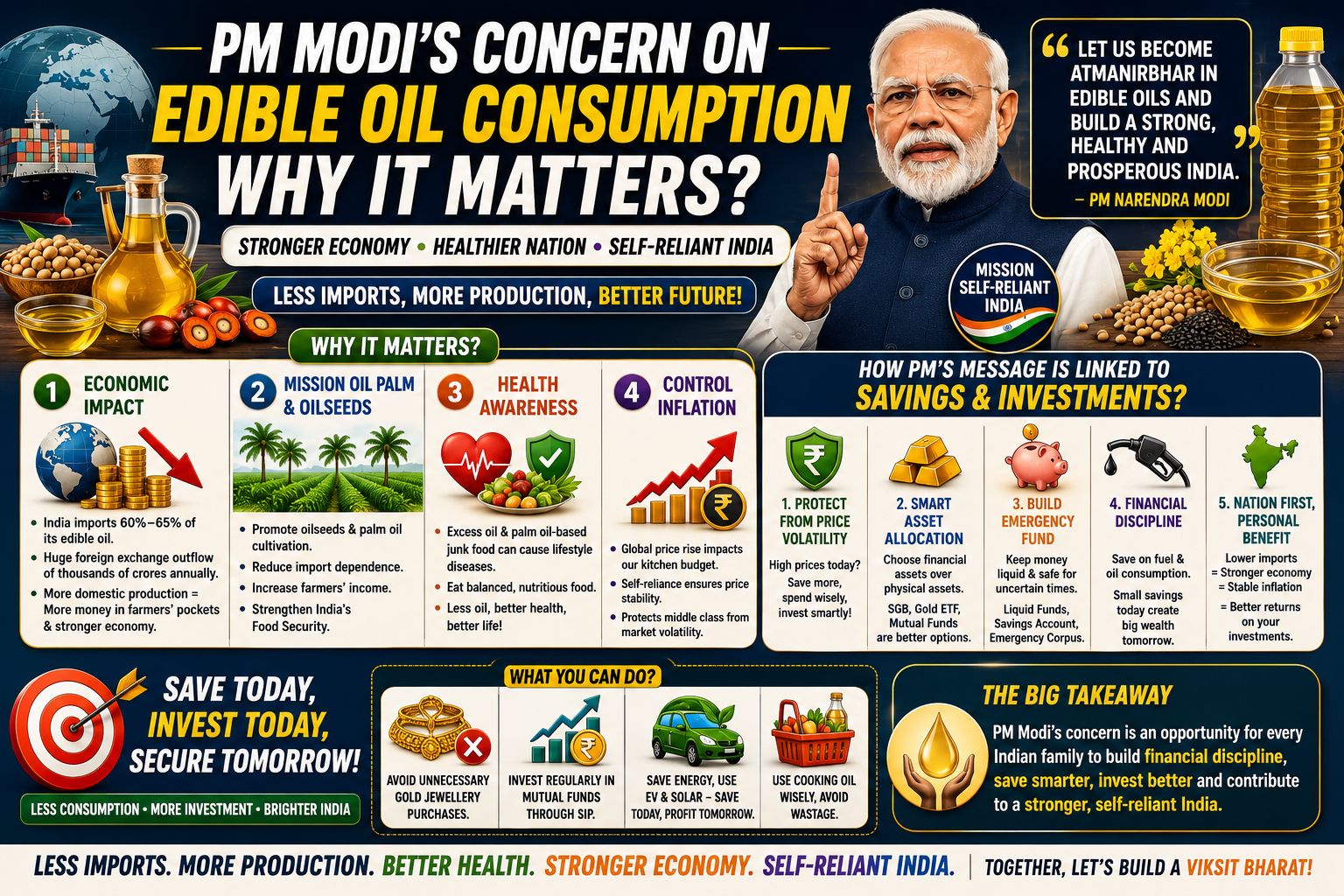
Narendra Modi recently expressed concern about India’s growing edible oil consumption and imports.
This issue is not only about economics, but also closely linked to:
- India’s financial strength,
- Farmers’ income,
- And public health.
1. Heavy Foreign Exchange Outflow (Economic Impact)
India imports nearly 60%–65% of its edible oil requirements.
Major suppliers include:
- Indonesia
- Malaysia
- Brazil
Why Important?
India spends billions of dollars every year on edible oil imports.
If domestic production increases:
- Farmers benefit,
- Import dependence reduces,
- And India becomes more self-reliant.
2. National Mission on Edible Oils – Oil Palm
The government is strongly promoting edible oil self-sufficiency.
Goals:
- Increase oilseed production
- Promote palm oil cultivation
- Encourage farmers toward diversified crops
Potential Benefits:
- Stronger food security
- Reduced imports
- Better rural economy growth
3. Health Concerns
The Prime Minister has repeatedly emphasized healthy eating and lifestyle awareness.
Main Concern:
Excessive oil consumption, especially palm oil-based junk food, may increase:
- Diabetes
- Heart disease
- Obesity
Key Message:
- Balanced diet
- Reduced oil usage
- Healthier lifestyle choices
4. Inflation Control
Global edible oil price increases directly impact household budgets in India.
If India becomes self-reliant:
- Prices may stabilize
- Dependence on global crises reduces
- Middle-class families get relief
How the Prime Minister’s Recent Statements Relate to Saving & Investing
The Prime Minister’s appeal to reduce excessive consumption of:
- Gold,
- Petroleum,
- Edible oil, it is directly connected to household financial planning.
1. Protection Against Price Volatility
When the government advises limiting consumption, it signals:
- Global prices are unstable,
- And unnecessary spending should be reduced.
Smart Financial Move:
- Avoid unnecessary purchases
- Increase savings
- Build investment capital
2. Shift in Asset Allocation
The message also suggests a shift from:
Physical Assets → Financial Assets
Better Alternatives:
- Sovereign Gold Bonds instead of jewelry
- Gold ETFs
- Mutual Funds
Benefits:
- Better liquidity
- Tax advantages
- Interest income potential
3. Importance of Emergency Funds
During uncertain economic times, liquidity becomes extremely important.
Therefore:
Avoid locking all money into:
- Gold
- Real estate
- Illiquid assets
Better Options:
- Liquid Funds
- Savings Accounts
- Emergency Corpus
4. Financial Discipline
Reducing fuel and edible oil expenses directly improves household savings.
Examples:
- Lower fuel consumption
- Reduced unnecessary expenses
- Better budget management
Result:
Small savings can become large investments over time.
5. National Interest + Personal Financial Benefit
When citizens reduce dependence on imported goods:
- Trade deficits improve,
- Inflation remains controlled,
- And the economy becomes stronger.
Long-Term Benefits:
- Better investment returns
- Stable interest rates
- Stronger economic growth
Final Conclusion
The Prime Minister’s message can be summarized as:
“Reduce Consumption, Increase Investment.”
Suggestions for Individuals
Gold:
Avoid unnecessary jewelry purchases.
SIP Investments:
Invest saved money systematically into mutual funds.
Energy Saving:
Consider:
- Electric Vehicles
- Solar Panels
- Energy-efficient lifestyles for long-term savings and wealth creation.
Final Learning
The Prime Minister’s concerns can actually become an opportunity for Indian families to:
- Build financial discipline,
- Increase savings,
- And create long-term wealth wisely.